The Quick Method for GST and QST: benefits, calculation and example
Under the Quick Method, the client charges GST and QST at the full rate, remits only a fixed percentage of sales and keeps the difference. For a small service business with few taxable expenses, that often adds up to a few thousand dollars a year.
In the files we take over from other firms, we almost always find the same two mistakes: the 1% credit was never claimed, and line 101 was filled in incorrectly.
Who can use it?
The Quick Method is reserved for small businesses. Their annual worldwide taxable sales, including those of their associates, must not exceed $400,000 (GST included) under the GST system, or $418,952 (QST included) under the QST system.
The threshold is tested over four consecutive fiscal quarters within the last five. Zero-rated sales count toward the total. Exempt sales, financial services, sales of real property or capital property, and the sale of goodwill do not.
Some businesses are excluded regardless of size. That includes businesses that provide legal, accounting or actuarial services, bookkeeping, financial or tax consulting, or tax return preparation. Designated financial institutions, charities and certain public bodies are not eligible either.
So your clients may well qualify. Your firm does not.
Who is the Quick Method best for?
The Quick Method is best for small suppliers that mostly sell services and buy few taxable goods. Their returns become much simpler: the remittance is calculated on sales, without adding up the tax paid on every operating expense. It is reserved for businesses whose taxable sales do not exceed $400,000.
| Client's situation | Best choice |
|---|---|
| Services, few taxable expenses, taxable sales under $400,000 | Quick Method |
| Resale of goods, purchases for resale of at least 40% of sales | Quick Method, at the reduced rate |
| High taxable operating expenses, above the break-even point | Regular method |
| Taxable sales above $400,000 (GST) or $418,952 (QST) | Regular method: the Quick Method is not allowed |
| Accounting or legal services, bookkeeping, tax return preparation | Regular method: these businesses are excluded |
- Best for self-employed people and small service businesses: a cleaning company, a photographer, a programmer. Their taxable expenses are low, so they give up few credits.
- Best for clients who want simpler bookkeeping: they no longer track the tax paid on operating expenses. Only purchases of capital property still need tracking.
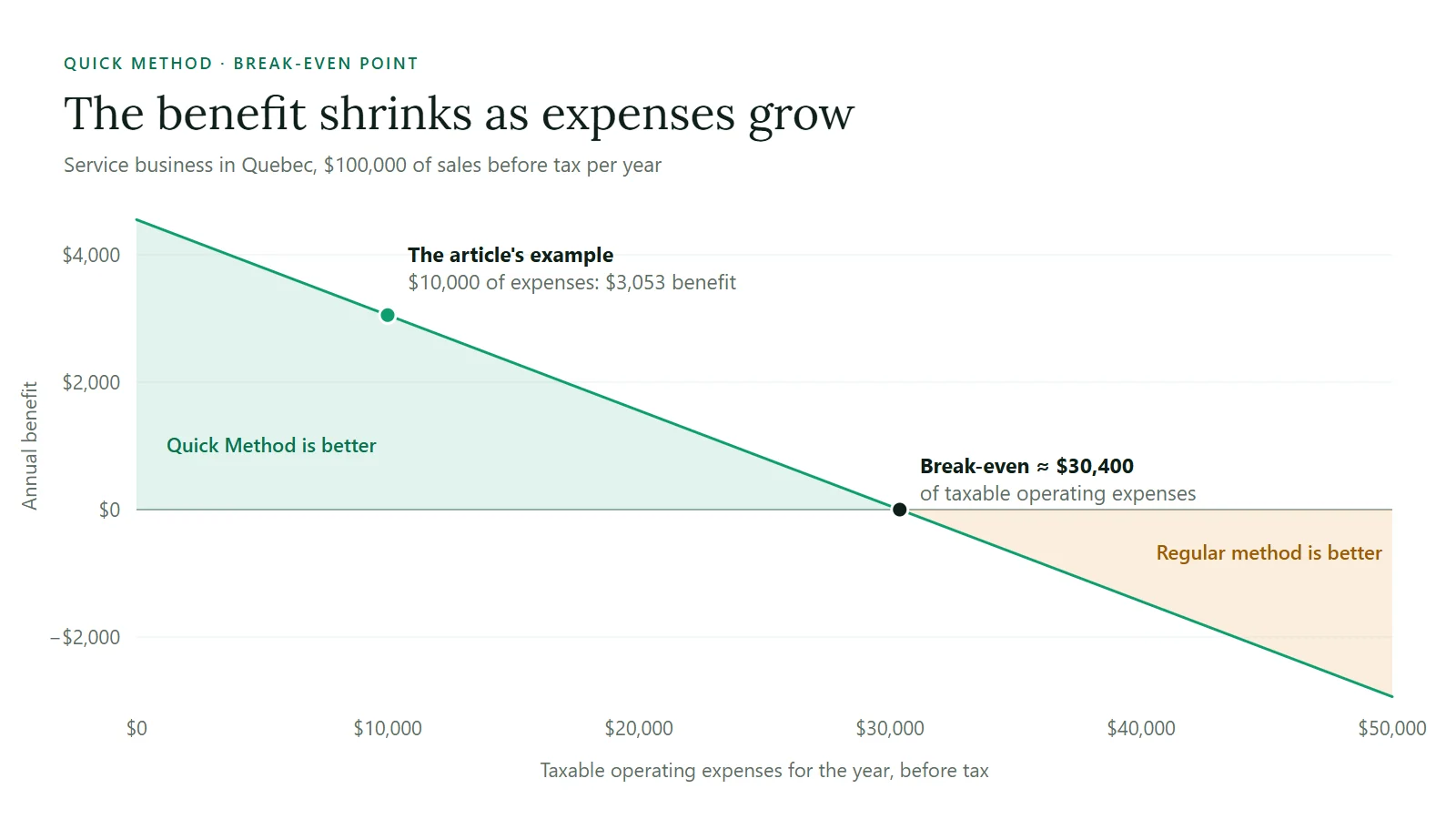
- Less worthwhile as expenses grow: every dollar of taxable expense is a credit given up. The break-even point depends on sales; for $100,000 of sales, it sits around $30,400 of taxable operating expenses (see the example below).
So the answer is not the same for every client. Review it every year, with that year's numbers.
Which rates apply
The rate depends on the province of the establishment and the type of business.
| Type of business | GST (Quebec) | QST (Quebec) | HST (Ontario) |
|---|---|---|---|
| Services (most businesses) | 3.6% | 6.6% | 8.8% |
| Resale of goods (retailers, wholesalers) | 1.8% | 3.4% | 4.4% |
The lower resale rate requires that the cost of goods purchased for resale be at least 40% of the year's taxable sales. A convenience store or a gas station usually qualifies. A repair shop, a caterer or a photographer uses the services rate.
What amount the rate applies to
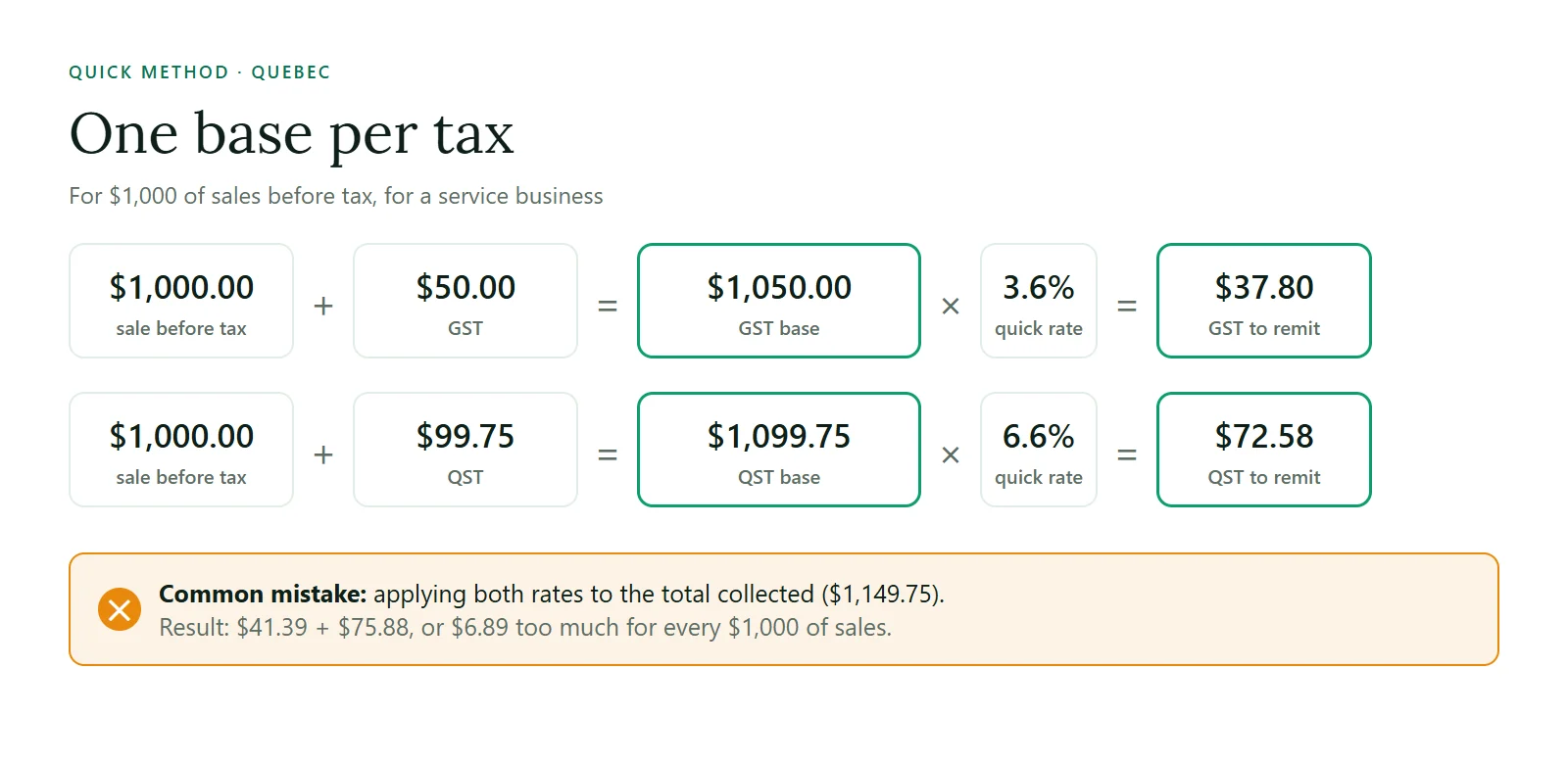
In Quebec, each rate applies to its own base. The GST rate is calculated on sales including GST, and the QST rate on sales including QST.
Take $1,000 of sales before tax. The GST base is $1,050 and the QST base is $1,099.75. If you apply both rates to the total collected, $1,149.75, both remittances come out too high.
Sales including GST are also what goes on line 101 of the GST return. This line is often filled in wrong, and the error repeats from one period to the next without anyone noticing.
Ontario is simpler: a single rate, applied to sales including HST.
The 1% credit: the mistake we see most
A client who has used the Quick Method since the beginning of the fiscal year, or since registering for GST and QST, is entitled to a 1% credit. It applies to the first $30,000 (GST included) of taxable sales for GST, and to the first $31,421 (QST included) for QST.
That is up to $300 of GST and $314 of QST a year. Most people do not know they are entitled to it, so the client ends up remitting up to $614 too much every year.
The credit is claimed from the first reporting period, then in the following ones, until the threshold is reached. Any unused portion cannot be carried forward to the next fiscal year. It is reported as an adjustment, on line 107 of the GST return and line 207 of the QST return.
What can still be claimed
The Quick Method replaces input tax credits on day-to-day expenses, but not on everything. The client can still claim input tax credits (ITCs) and input tax refunds (ITRs) on purchases of capital property, such as a computer, a vehicle or equipment, and on real property.
The reverse is true as well. The reduced rate only applies to sales made in the ordinary course of business. When the client sells used equipment or land, the full tax must be remitted.
A complete example
A cleaning business in Quebec has used the Quick Method since the start of its fiscal year and files once a year. Its sales for the year total $100,000 before tax, and its taxable operating expenses $10,000 before tax. It bought no capital property.
Taxes collected from customers
| GST | QST | Total | |
|---|---|---|---|
| Taxes charged (5% and 9.975%) | $5,000.00 | $9,975.00 | $14,975.00 |
Remittance under the Quick Method
| GST | QST | |
|---|---|---|
| Base (sales, tax included) | $105,000.00 | $109,975.00 |
| Applicable rate | 3.6% | 6.6% |
| Calculated amount | $3,780.00 | $7,258.35 |
| 1% credit ($30,000 / $31,421) | − $300.00 | − $314.21 |
| To remit | $3,480.00 | $6,944.14 |
It remits $10,424.14 of the $14,975.00 collected, and keeps $4,550.86.
Under the regular method, it would have remitted the taxes collected minus its credits on expenses: $14,975.00 − $500.00 (ITCs) − $997.50 (ITRs), or $13,477.50. The Quick Method therefore saves it $3,053.36 this year.
The break-even point
Every dollar of taxable expense is a credit the client gives up. The more expenses grow, the more the benefit shrinks. In this example, the regular method becomes more advantageous above roughly $30,400 of taxable operating expenses. That is the number to watch every year when advising the client: stay on the Quick Method, or leave it.
The benefit is income
What the client keeps is not tax-free: it is part of the business's income. At year-end, the adjusting entry removes from revenue the taxes included in sales, at the regular rate, then records the Quick Method benefit as separate income. The year's results then show the real gain.
Making the election
In Quebec, the election is made with Revenu Québec on form FP-2074, for GST and QST at the same time. Elsewhere in Canada, it is made with the CRA on form GST74.
A monthly or quarterly filer sends it no later than the due date of the return for the first period covered. An annual filer, no later than the first day of the second quarter of the fiscal year covered.
The election stays in effect as long as the business remains eligible. It must be kept for at least one year before it can be revoked.
The mistakes we correct most often
- The 1% credit forgotten: up to $300 of GST and $314 of QST a year, lost.
- A line 101 that does not show sales including GST.
- Both rates applied to sales including all taxes, instead of each tax's own base.
- The reduced rate applied to the sale of capital property, which requires remitting the full tax.
- ITCs and ITRs on capital property never claimed.
- The benefit never recorded as income at year-end.
- A client kept on the Quick Method out of habit, when expenses have grown and the regular method would cost less.
How Ledger handles it
In Ledger, the Quick Method is a working paper in the engagement file, ideal for firms with several clients on the Quick Method. You enter the province, the type of business and the filing frequency, then the sales for each period, which you can also pull straight from the general ledger. The rest is calculated for you:
- the remittance for each period, with the right base for each tax, the 1% credit up to the threshold and the credits on capital property;
- the comparison with the regular method, with the year's benefit and the expense break-even point, so you can advise the client with numbers in hand;
- the entry for each period and the year-end entry, ready to post to the trial balance.
The 1% credit, in particular, can no longer be forgotten. Quebec (GST and QST), Ontario (HST) and the provinces where only the GST applies, such as Alberta, are supported.
To set it up in a file, follow the help centre guide: the Quick Method and sales tax reconciliation.
Try Ledger free for 45 days
No credit card, with a one-hour video conference walkthrough to get you started.
Start my free trial →Sources: Revenu Québec, The Quick Method of Accounting for Calculating GST and QST Remittances; CRA, Guide RC4058, Quick Method of Accounting for GST/HST. Rates in effect in October 2026. This article is general in nature and does not replace advice tailored to your situation.