CSRS 4200 compilation engagements: a practical guide, from acceptance to the report
For almost 35 years, a compilation ended with a Notice to Reader a few lines long. For periods ending on or after December 14, 2021, that is over: CSRS 4200, Compilation Engagements, replaced the old Section 9200, and the Notice to Reader gave way to the compilation engagement report.
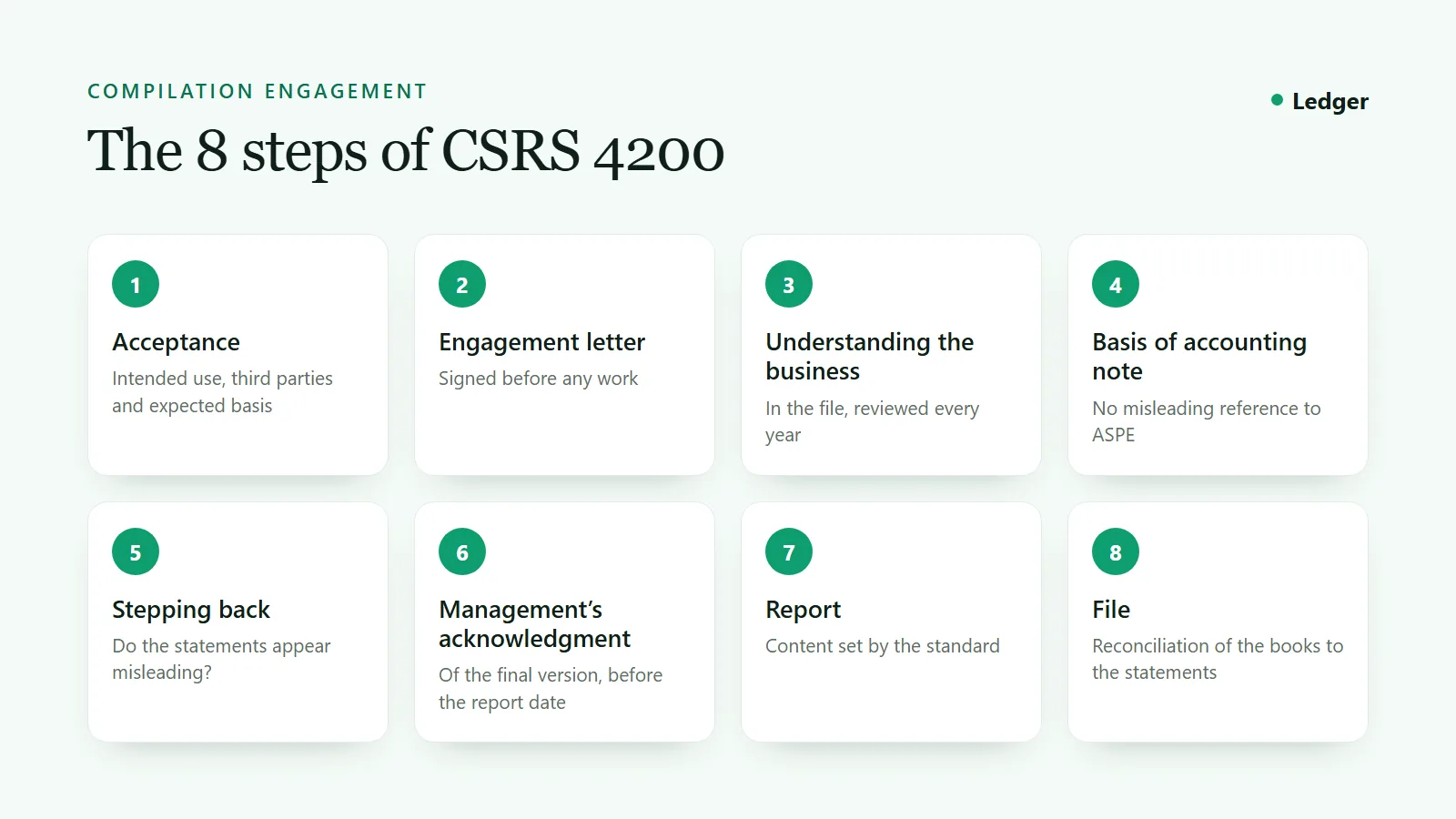
Yet the report is not the biggest change. The standard also requires you to document the acceptance of the engagement, describe the basis of accounting in a note, obtain management's acknowledgment of the final version of the statements and keep a reconciliation of the books to the statements in the file. Those are the points inspectors flag most often.
When we take over files from other firms, that is often where things go wrong. The accountant did not take the time to really get to know the business, or at least did not write it down. The engagement guides and forms were not followed, and sometimes the firm did not even have them. The statements were produced and the report was signed, but nothing in the file shows how anyone got there.
What changed with CSRS 4200
Section 9200 is no longer permitted. CPA Canada said so again in 2023: inspectors were still seeing compilations performed under the old standard, sometimes simply because the firm's template had never been updated.
The standard also clarified its scope. If your client only needs bookkeeping or a tax return, and you do not issue any communication associated with your work, you are not performing a compilation engagement within the meaning of CSRS 4200.
Finally, quality management now applies to compilations. CSQM 1 covers related services engagements, and firms had to design and implement their system by December 15, 2023. For a small firm that only does compilations, that was often a first.
Compilation, review or audit: which one fits your client?
A compilation engagement is best for small businesses whose financial statements are used by management, for the tax return, or by a lender that accepts compiled statements. It provides no assurance. When a reader requires assurance, you need a review or an audit.
| Engagement | Best for | Level of assurance |
|---|---|---|
| Compilation (CSRS 4200) | Management, the tax return, a lender that accepts compiled statements | None |
| Review (CSRE 2400) | A lender or investors who require limited assurance | Limited |
| Audit (CAS) | A requirement of law, a contract or a lender, or shareholders who do not manage the business | Reasonable |
And if the client wants statements that fully comply with ASPE, the standard invites you to ask whether a review or an audit would better meet its readers' needs.
1. Before you accept: intended use and basis of accounting
It all starts with a simple question to the client: what will these financial statements be used for, and who else will read them?
Take Rénovations Exemple inc., a contractor who needs statements to renew a line of credit. A third party, the bank, will use them. The standard then sets a condition: the third party must be able to obtain further information from the business, or must have agreed with management on the basis of accounting. An account manager who can call the client and ask for details meets the first one. You do not need to contact the bank yourself: management's acknowledgment is enough.
At the same step, management acknowledges the basis of accounting you expect to apply. A short written note, an email or a conversation documented in the file (who, when, what) will do. The basis can still change during the engagement; it is the final version that will be acknowledged at the end.
Independence, for its part, is not required by the standard. You still have to assess it: a threat that cannot be mitigated must be disclosed in the report.
2. The engagement letter, signed before you start
The engagement letter is signed before any work begins, not at the same time as the statements. It sets out the objective and scope of the engagement, the intended use of the statements and the third parties who will use them, each party's responsibilities and the expected form of the report.
For a recurring client, the question comes up every year: is a new letter needed? If you do not renew it, management must still acknowledge its responsibilities for the year.
3. Know the business, and write it down
The standard requires your understanding of the business to be in the file: its operations, its accounting system, its accounting records, the basis of accounting applied and, where applicable, the significant accounting policies. The accountant sometimes knows the client very well, but if nothing is written down, the requirement is not met.
From one year to the next, you start from what was documented last year: confirm what has not changed and note what has, such as a new loan, a change of software or a new line of business.
4. The basis of accounting note
The new standard requires the compiled statements to include a note describing the basis of accounting applied, so that readers understand how they were prepared.
The most common bases are the cash basis, the cash basis with selected accruals and estimates, or a basis set by a contract, for example one a lender requires. For a small business, the note often looks like this:
The basis of accounting applied in the preparation of the financial information is the historical cost basis, reflecting cash transactions with the addition of the following: accounts receivable, net of an allowance for doubtful accounts; property, plant and equipment, amortized over their estimated useful lives; accounts payable and accrued liabilities; income taxes payable as at the year-end.
Be careful with references to ASPE. In inspections, a number of notes were found misleading because they mentioned Accounting Standards for Private Enterprises when the statements did not meet all of them. A typical compilation has no cash flow statement and not all the required notes, which already puts it on a different basis.
So the note cannot imply full compliance with ASPE unless every recognition, measurement, presentation and disclosure requirement is met. Nor can it use vague wording such as "complies substantially with ASPE." And if the client truly needs statements that comply with ASPE, the standard suggests asking whether a review or an audit would better meet the needs of its readers.
5. Step back before you issue
When the firm helped management with significant judgments, such as the choice of basis or an estimate, you discuss them with management and document them in the file.
Before you issue, you then read the compiled statements in light of what you know about the business, and ask yourself whether they appear misleading. At a retailer, inventory that has not moved in three years should raise a flag, as should a large shareholder advance buried in accounts payable or a loan whose balance does not match the amortization schedule. If something looks off, you ask management to correct it. If management refuses, you do not issue the statements, and you withdraw from the engagement where the rules allow it.
6. Management's acknowledgment and the report date
At the end of the engagement, management acknowledges its responsibility for the final version of the statements, basis of accounting included. Three forms are accepted: signing the statements, a written communication, or an oral acknowledgment documented in the file with the person's name and the date.
The report cannot be dated before that acknowledgment. A report dated the day you finished the statements, when the client approved them a week later, is dated too early. It is a point often raised in inspections, and it is easy to avoid: you date the report on the day the acknowledgment is obtained, or later.
7. The compilation engagement report
The content of the report is set by the standard and cannot be modified. Only a few additions are provided for, such as disclosing a threat to independence.
In substance, the report says that the firm compiled the named statements, along with the note describing the basis of accounting, on the basis of information provided by management. Management is responsible for the accuracy and completeness of that information, and for selecting the basis of accounting. The firm followed CSRS 4200 and the rules of professional conduct; its role was to assist management in preparing the statements. It performed neither an audit nor a review, was not required to verify the information received and provides no form of assurance. Finally, the report cautions readers that the statements may not be appropriate for their purposes.
Two details are worth checking. The report names only the statements actually presented: if you do not deliver a cash flow statement, it must not appear. And it refers to the right note number for the basis of accounting, the one the note actually carries in the statements.
8. What the file must contain
The standard sets the minimum content of the file:
- the engagement letter;
- your understanding of the business and the basis of accounting applied;
- a reconciliation of the entity's accounting records to the compiled statements, including the adjusting entries agreed with management;
- discussions with management about significant judgments;
- communications about matters that could have made the statements misleading, and how they were resolved;
- the final version of the compiled statements, acknowledged by management;
- the report;
- where applicable, the reasons for withdrawing from the engagement.
The test to keep in mind: an experienced practitioner who has never worked on the file must be able to understand it.
The mistakes we see most often
Forms from another year. This is the one we run into most. Every year, the firm fills in forms from a prior period, copied from one file to the next, even though they no longer meet today's requirements. The file looks complete, but it answers to a version of the standard and the guides that has since changed.
An old report template. The Notice to Reader is still printed out of habit, or the report still uses the old wording.
A note that cites ASPE. Yet the statements have no cash flow statement and not all the required notes.
A report that does not match the statements. It names a statement that is not presented, or refers to a note with the wrong number.
A date that is too early. The report is dated before management acknowledged the final version.
Undocumented acceptance. Nobody recorded the intended use or the existence of a third party.
No reconciliation in the file. The entries were posted, but nothing links the client's books to the figures in the statements.
How Ledger handles it
Ledger is ideal for firms of 1 to 10 people that mainly do compilation engagements. We built the compilation engagement in Ledger around these steps, in the order they happen. Everything sits in the client's file, in the same place as the trial balance and the financial statements.
- The engagement forms (acceptance, understanding of the business, completion, report release) are filled in within the file and save automatically. An unfavourable answer asks for a justification.
- Our team reviews the forms every year so they follow current requirements, and every firm works with the up-to-date version. Nobody has to replace an old template on their computer.
- From one year to the next, the understanding of the business brings last year's answers into this year's form, never into the old one. You confirm what has not changed and correct the rest.
- The engagement letter is built from paragraphs you tick, including those specific to Quebec or to the rest of Canada. The acknowledgment of management's responsibilities and the letter to the predecessor firm are ready too.
- The basis of accounting note starts from a model you adapt to the business.
- The report names only the statements you print and refers to the real number of the basis of accounting note, in English or in French.
- The trial balance shows the balances in the books, the adjusting entries and the balances in the statements: the reconciliation is in the file.
- The client portal is where you receive documents and have them signed.
To assemble the report, statements and notes, then send them to the client, see the help centre guide: assemble and send the financial statements.
Frequently asked questions
Is the Notice to Reader still permitted?
No. For periods ending on or after December 14, 2021, a compilation ends with the CSRS 4200 compilation engagement report. Section 9200 is no longer permitted.
Can we reuse last year's forms?
The answers, yes, once they are confirmed for the new year. The forms themselves, no: use the current version every year, because the requirements and the guides change.
Is a cash flow statement required in a compilation?
No, the standard does not require one. Most compilations present a balance sheet, an income statement and a statement of retained earnings. The report names the statements actually presented.
Can we say the statements are prepared in accordance with ASPE?
Only if they meet every ASPE requirement. Otherwise, the note describes the basis actually applied, without wording such as "substantially."
Does the firm have to be independent?
The standard does not require it, but independence must be assessed. A threat that cannot be mitigated must be disclosed in the report.
Do we have to contact the bank when it will use the statements?
No. Management acknowledges that the bank can request further information from it, or that it has agreed with the bank on the basis of accounting. That acknowledgment is enough.
Try Ledger free for 45 days
No credit card, with a one-hour video conference walkthrough to get you started.
Start my free trial →References: CPA Canada Handbook, Assurance, CSRS 4200, Compilation Engagements; CPA Canada, CSRS 4200 Practitioner's Implementation Tool; Svetlana Berger, "The New Compilation Engagements Standard: How are you managing?", CPA Canada blog, February 8, 2023; CPABC, CSRS 4200 FAQ. Fictional example. This article is general in nature and does not replace reading the standard or advice tailored to your situation.